Garmin Fenix 8 Pro AMOLED Review
The Garmin Fenix 8 Pro AMOLED is the best fitness-focused wearable on the market — works with both iPhone and Android, delivers class-leading workout data, multi-week battery life, and exceptional build durability. It's not a smartwatch, and that's exactly the point.
Buy Garmin Fenix 8 Pro → $1,299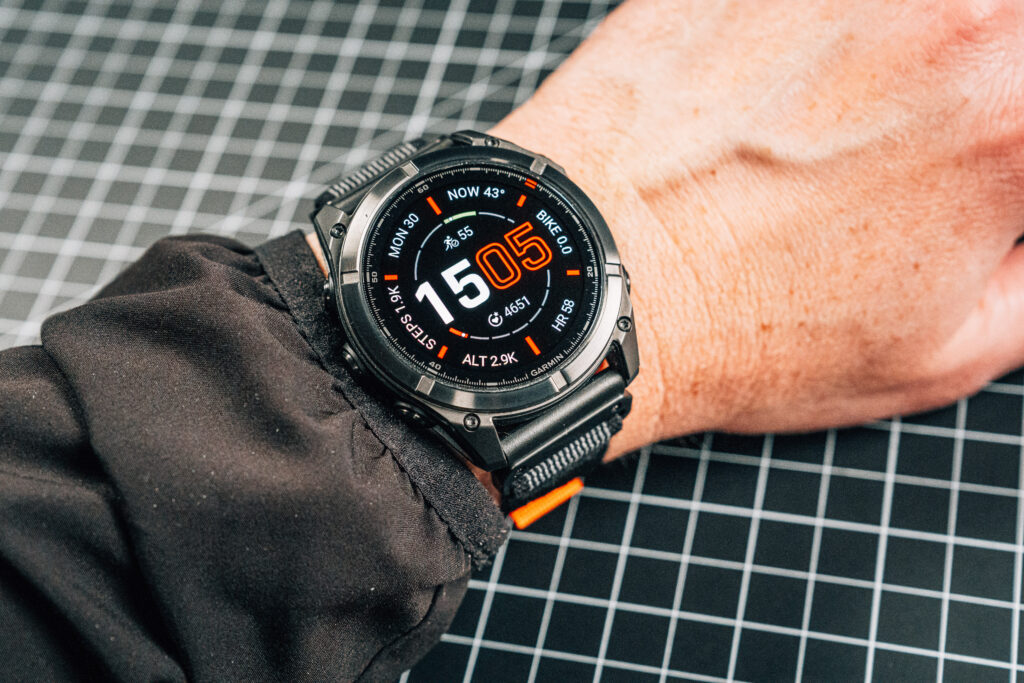
What We Like
- Class-leading fitness tracking with more workout types, data fields, and analytics than any competing wearable
- Multi-week battery life — real-world testing showed 18+ days remaining after several days of active use
- Works with both iPhone and Android via Garmin Connect — not locked to a single phone ecosystem
- Exceptional build quality with minimal cosmetic wear even after extended daily use
- Garmin inReach satellite messaging enables communication completely outside of cellular coverage
- Genuinely bright flashlight accessible via double-tap button — a practical daily-use feature
What Could Improve
- No traditional cellular connectivity — cannot receive standard calls or texts independently from your phone
- Closed software ecosystem with a limited Connect IQ app store compared to open wearable platforms
- Music requires manual syncing via phone ahead of time — no live cellular streaming during workouts
- At $1,299, the price requires a fitness-focused use case to justify over capable alternatives
- Button-driven navigation has a learning curve for users coming from full touchscreen wearables
Who This Watch Is For
The Garmin Fenix 8 Pro AMOLED is not a smartwatch. I want to be clear about that upfront, because how you categorize this device determines whether $1,299 feels like a lot of money or a reasonable investment. If you’re looking for a watch that mirrors your phone’s notification experience, handles mobile payments seamlessly, and responds to touch gestures like a wrist-mounted smartphone — this isn’t it. If you want the most capable fitness and activity tracker you can put on your wrist, with battery life that removes charging anxiety entirely, the Fenix 8 Pro is the answer.
It works with both iPhone and Android via the Garmin Connect app, so it’s not a platform-specific purchase. Whatever phone you carry, the Fenix 8 Pro connects to it and syncs your data. What it asks in return is that you prioritize fitness over phone features — and for the right person, that’s not a compromise at all.
Design & Build Quality
The Fenix 8 Pro looks exactly like what it is: a serious sport watch. The circular case with a five-button layout has been Garmin’s design signature for years, and they haven’t changed it because it works. Buttons are accessible with gloves, easy to press mid-workout, and positioned logically so muscle memory develops quickly. This isn’t a watch trying to look like jewelry — it’s a tool built for use.
Where the Fenix 8 Pro genuinely surprises is long-term durability. I’ve been wearing this watch since launch day, and outside of one hard knock that left a faint mark I have to actively look for, the watch looks essentially brand new. No scuffs from pocket friction. No bezel wear from daily handling. Whatever Garmin is doing with their materials and finishing process, it holds up to real-world daily use in a way that most premium wearables don’t.
The band has similarly held up well — no discoloration, no visible wear. A watch at this price should still look premium after a year of daily use, and the Fenix 8 Pro delivers that.
One design detail worth highlighting specifically: the top-left button doubles as a flashlight activator via double-tap. This sounds like a minor convenience feature and has turned into something I use every single day. I’m up around 4 a.m. for workouts, and navigating downstairs without waking the house with overhead lights is genuinely useful. The flashlight is bright — a real, usable light source, not a faint glow. Small detail, meaningful daily impact.
Display
The Fenix 8 comes in three display configurations: standard LCD, AMOLED, and MicroLED. This review covers the AMOLED version. Having spent time with all three variants, the AMOLED is the sweet spot in the lineup. The MicroLED difference is subtle in everyday use, and the price jump is hard to justify for most buyers.
The AMOLED panel is bright, sharp, and readable in all lighting conditions including direct sunlight. During workouts, data fields — pace, heart rate, distance, intervals — are easy to read at a glance without breaking stride. Colors are vivid and the always-on display works well without dramatically impacting battery life, which is an impressive engineering achievement given how aggressively Garmin optimizes for power efficiency.
Navigation is primarily button-driven rather than touch-gesture-forward. This is a deliberate choice. During workouts — especially in wet conditions, with gloved hands, or at high intensity — physical buttons are more reliable than a touch screen. The display does support touch input for swiping through glanceable data panels, but the core interaction model is five-button navigation. It takes a short adjustment period if you’re used to full touchscreen wearables; after that, the layout becomes second nature.
Fitness Tracking
This is the Fenix 8 Pro’s defining capability, and where it has no equal at any price point in the wearables market.
The breadth of supported workout types is comprehensive — from standard running, cycling, and swimming to trail running, mountaineering, skiing, paddleboarding, and dozens of others. Each activity type has fully customizable data fields, so you surface exactly the metrics that matter to you for that specific workout. You’re not locked into a default layout; you’re building dashboards per activity.
Beyond workout logging, the Fenix 8 Pro delivers training load analysis, recovery time recommendations, VO2 Max tracking, Body Battery energy monitoring, sleep staging, HRV status, and race predictor tools. The Body Battery metric — which tracks your energy reserves across the day based on stress, sleep quality, and activity — is one of the most practically useful features I’ve encountered in any wearable. It changes how you think about scheduling hard workouts versus recovery days.
Heart rate accuracy during workouts was consistently reliable throughout my testing. GPS acquisition is fast, and tracking accuracy on outdoor runs and rides was strong. The Garmin Connect app provides a clean interface for reviewing workout history, trends, and long-term fitness data — and it’s one of the better fitness platforms available on any phone platform.
One standout safety feature: Garmin inReach satellite messaging. If someone on the other end has the Garmin Messages app, you can send and receive messages via satellite even when you’re completely outside of cellular coverage. For trail runners, hikers, and anyone who ventures into backcountry, this is a genuine safety capability — not a marketing bullet point.
Battery Life
The Garmin Fenix 8 Pro AMOLED delivers battery life that still surprises me, even having used Garmin watches for years.
During testing, after several days of active use including workouts, overnight sleep tracking, and continuous heart rate monitoring, the watch showed 73% battery remaining with 18 days of estimated life left. That’s real use — not a controlled lab scenario with GPS off and the display dimmed.
The reason Garmin achieves this while other wearables struggle is architecture. The Fenix 8 runs a closed, heavily optimized operating system that isn’t constantly syncing at high frequency or running dynamic background processes. Data updates happen on a deliberate cadence. This is a tradeoff — the experience is less phone-like on the wrist — but for users who want to stop thinking about charging, it’s an excellent tradeoff.
For multi-day trips, extended travel, or simply not wanting another device to manage in your daily charging routine, the Fenix 8 Pro’s battery life is genuinely category-defining.
Software & Apps
The Garmin ecosystem is mature and intentionally closed. The watch runs Garmin’s own operating system, and while there is a Connect IQ app store with third-party watch faces, widgets, and data fields, it’s a more curated software environment than open platforms. You’re not installing apps in the traditional smartphone sense — and for most Fenix users, that’s fine, because the native software covers the use cases they bought the watch for.
The native workout interface is clean, fast, and highly configurable. Garmin Connect on both iOS and Android is one of the more polished companion apps in the wearable space, offering deep analytics, training plans, and long-term trend visualization. Integration with third-party fitness platforms like Strava and TrainingPeaks is well-supported.
Music management requires some setup — you sync music to the watch via Bluetooth from supported streaming services through your phone ahead of time. There’s no live streaming, so the watch functions as a local storage player during workouts. It works well once configured; it just requires that pre-planning step. For workouts where you want to leave your phone behind, it’s a capable solution.
Connectivity
The Fenix 8 Pro connects to your phone via Bluetooth and supports Wi-Fi for syncing data when your phone isn’t nearby. It is compatible with both iPhone and Android — the Garmin Connect app delivers the same experience on both platforms, making it a genuinely cross-ecosystem wearable.
There is no traditional cellular plan on this watch. It cannot make or receive standard calls and texts independently from your phone. What it does have is Garmin inReach satellite messaging — the ability to communicate via satellite when cellular doesn’t exist at all, provided the person contacting you is using the Garmin Messages app. For backcountry use cases, this is more valuable than standard cellular. For everyday connectivity away from your phone, it’s a meaningful limitation to understand before buying.
Bluetooth audio for headphones works reliably. Garmin Pay is available for contactless payments where supported. Overall, connectivity is purpose-built for the athletic and outdoor use cases the watch targets — comprehensive where it needs to be, deliberately limited where smartwatch features would compromise the core experience.
Value
At $1,299, the Fenix 8 Pro AMOLED is a significant investment. The value case rests on two arguments.
First, this watch is built to last. It shows no meaningful cosmetic wear after extended daily use, and Garmin’s track record for multi-year software support across their lineup is strong. Amortized over three to five years of ownership, the per-year cost becomes considerably more reasonable.
Second, there is no competing product that delivers the combination of fitness data depth, multi-week battery life, platform-agnostic compatibility, and build durability that the Fenix 8 Pro offers together. If those things matter to you, you’re not overpaying — you’re buying the only watch that actually delivers all of them.
If you’re a casual fitness tracker who primarily wants activity awareness alongside smartwatch convenience, the value doesn’t hold at this price and there are better-suited options available for less. But if fitness is central to how you live and you’ve hit the ceiling on what mainstream wearables can tell you, the Fenix 8 Pro AMOLED is worth the investment.
Final Verdict
The Garmin Fenix 8 Pro AMOLED earns its price tag for the right buyer. It is the most capable fitness and activity tracker available on any platform — full stop. The workout data depth, the inReach satellite messaging, the Body Battery and HRV recovery tools, the multi-week battery life, and the build quality that holds up after years of daily wear all represent the best available in their respective categories.
It works with both iPhone and Android, which makes it a rare wearable that isn't tethered to a single ecosystem decision. Whatever phone you carry, the Garmin Connect app delivers the same experience. That platform flexibility is genuinely useful for people who switch phones or simply don't want a watch tied to their current device choice.
Where it asks for compromise is in smartwatch features. Notifications are functional but not deeply integrated. There's no independent cellular. The software ecosystem is closed. If those features are central to why you wear a watch, there are platform-specific options better suited to that use case.
Buy the Garmin Fenix 8 Pro AMOLED if you're a serious athlete, an outdoor enthusiast, or a data-driven fitness person who has outgrown what mainstream wearables can provide. The $1,299 price is justified by what it delivers — and by a build quality that means you won't be replacing it anytime soon.
Consider other options if you primarily want a smartwatch with strong phone integration and your fitness needs are casual to moderate. The Garmin will feel like overkill, and you'll be paying for capabilities you don't use.
Was this helpful?
Frequently Asked Questions
Does the Garmin Fenix 8 Pro work with iPhone?
How long does the Garmin Fenix 8 Pro AMOLED battery last?
What is the difference between the Garmin Fenix 8 AMOLED and MicroLED?
Is the Garmin Fenix 8 Pro AMOLED worth $1,299?
Can the Garmin Fenix 8 Pro receive calls and texts without a phone?
